
Tackling precarity through policy:
The People’s Policy Forum debates policy change from the bottom up
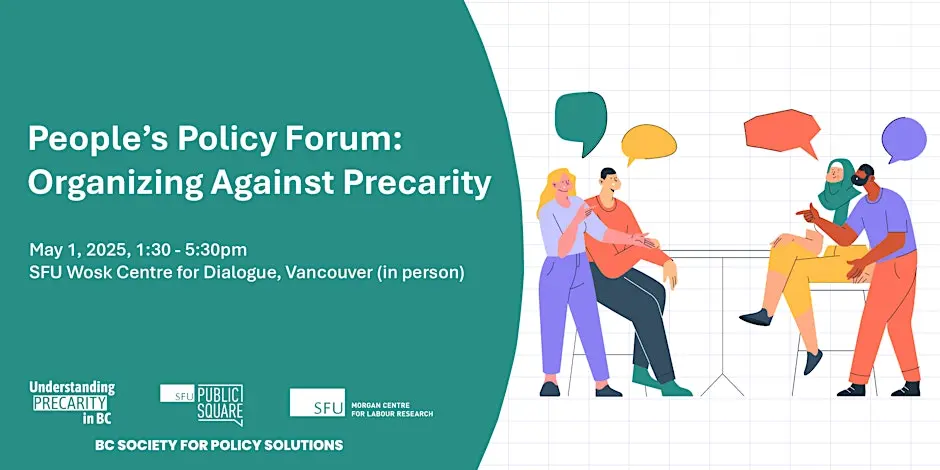
On May 1st, 2025 – international workers’ day – the Understanding Precarity in BC (UP-BC) research partnership organized a People’s Policy Forum (PPF) on the theme of Organizing Against Precarity. Attended by more than 100 workers, students, activists and organizers, from a wide range of unions, community-based organizations, service providers, universities, and think tanks, the Forum brought people together to talk about the biggest policy issues and challenges we are face today, and how we move from ideas to action in our struggles for justice and against precarity in our province.
Starting the conversation – big challenges need big ideas
The PPF kicked off with four leading-edge speakers talking about big challenges and big ideas, moderated by climate activist Seth Klein:
- Denise Moffat from the BC Federation of Labour discussed progressive policy ideas that our government has already committed to and how we hold them to account
- Dr. Stephanie Dick talked about how the current deployment of artificial intelligence (AI) relies on extractivism and is a political choice, not an inevitability
- Katisha Paul reminded us that the climate crisis is the product and outcome of colonialism on local and global scales, while missing and murdered Indigenous women and girls bear the costs of its violence
- Dr. Adel Iskander spoke to the context of social and resistance movements at home and internationally to speak to the early promise of social media and the current realities of disinformation and deepening polarization
Fostering discussion – from identifying problems to organizing the fightback
Building on the big ideas in the opening panel, PPF participants joined breakout sessions on the themes of Migration, Immigration and Precarity; Climate Justice; Building an Inclusive Economy; and Countering the Anti-Equity Backlash.
Policy challenges we face:
- Migrants to Canada are being blamed and scapegoated for the precarity people experience in employment, housing, and healthcare (among others). But discriminatory and racist immigration policy, economic exploitation, and complex and unfair changes to policy lead to the extreme precarity of migrants who want to contribute to our economy and society. Now, Bill C-2 will make things much worse and put us on a US-style path to surveillance, targeting and deportations.
- Tackling climate change has become a polarized issue and governments at all levels are using geopolitical instability to double down on extractivist policies that trample Indigenous rights. We are locking in a settler colonial growth model even as workers and communities struggle with accelerating climate change impacts.
- Workers face a polarized economy with high levels of precarious employment, increasing prevalence of gig and app-based work, and rising inequality in earnings and wealth. Companies are using automation and AI to threaten and cut jobs, while some sectors are still reeling from the impacts of the COVID-19 pandemic.
- A well organized and funded backlash against equity, diversity and inclusion (EDI), anti-racism, reconciliation, gender equality and queer and trans rights is trying to roll back the policy gains that have been made in these areas. White supremacist, misogynistic, queer- and trans-phobic and ableist discourse and policies are gaining ground across the country.
We are the ones we are waiting for! – towards a People’s Policy Agenda
As the lively discussions in our breakout groups showed, we have ideas for policy solutions that center equity, promote justice, and tackle widespread, multidimensional precarity.
What’s next?
Our conversations at the PPF emphasized coalition building, long-term organizing, and working across silos. Organizing against multi-dimensional precarity means articulating and strategizing for policies that benefit working people and our communities, that refuse scapegoating and advance justice and liberation, and that recognize our fundamental interconnectedness with one another and with the environment on which we depend.