
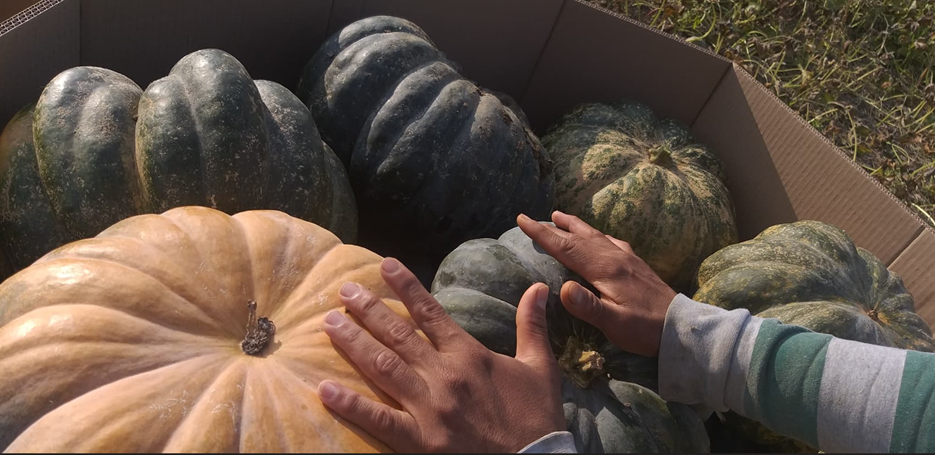
On October 17, 2025, Simon Fraser University’s (SFU) David Lam Centre and Labour Studies Program, and the Understanding Precarity in BC (UP-BC) Project, hosted a stimulating and thought provoking hybrid (in person and online) roundtable titled “Im/migrant Farmworker Justice in British Columbia and Ontario: Past and Present Struggles and Change for the Future.”
Led and curated by Dr. Evelyn Encalada Grez (Assistant Professor, SFU Sociology and Labour Studies Program, and organizer, Justicia for Migrant Workers, BC), this hybrid event grouped a range of migrant justice community groups, academics, and community-labour organizers to share their insights on intergenerational farmworker struggles in British Columbia and Ontario.
Background context
Little is known about the historical legacy of farmworker resistance in British Columbia and of the contemporary roots of migrant farmworker organizing in Ontario. These are important working-class struggles that merit wider acknowledgement and attention.
Farmworkers are among the most-precarious workers not only in Canada but throughout the world. Their labour is essential for basic human survival, yet farmwork is considered among the 3D jobs—dirty, demanding, and dangerous. Injuries, illnesses, and fatalities are common as farmworkers engage in often dangerous mechanized production processes and in highly toxic environments full of pesticides, insecticides, and fertilizers of all sorts. Farmworkers are poorly paid and in general, do not count on strong labour laws to protect their labour and human rights. Production supersedes the rights and wellbeing of farmworkers for the multibillion-dollar agricultural industry and production is protected through socio-legal means under the guise of “national food security.” Therefore, farmworkers fall under legal exceptionalism and deliberate exclusions from basic labour rights such as overtime pay, the right to unionize, and to health and safety protections, varying slightly across provincial jurisdictions.
In British Columbia, South Asian immigrant farmworkers, principally from Punjab, have comprised most of the agricultural labour force since the 1960s. In 2004, migrant farmworkers from the Global South started to be recruited by farming employers through Canada’s Temporary Foreign Worker Programs (TFWPs) for agriculture. These include two principal programs, the Seasonal Agricultural Workers Program (SAWP) and the TFWP-Agricultural Stream. While the demographics of workers have shifted, the landscape of precarity, systemic racism, rural isolation and socio-legal exclusions remains. So too does the fight for farmworkers’ rights.
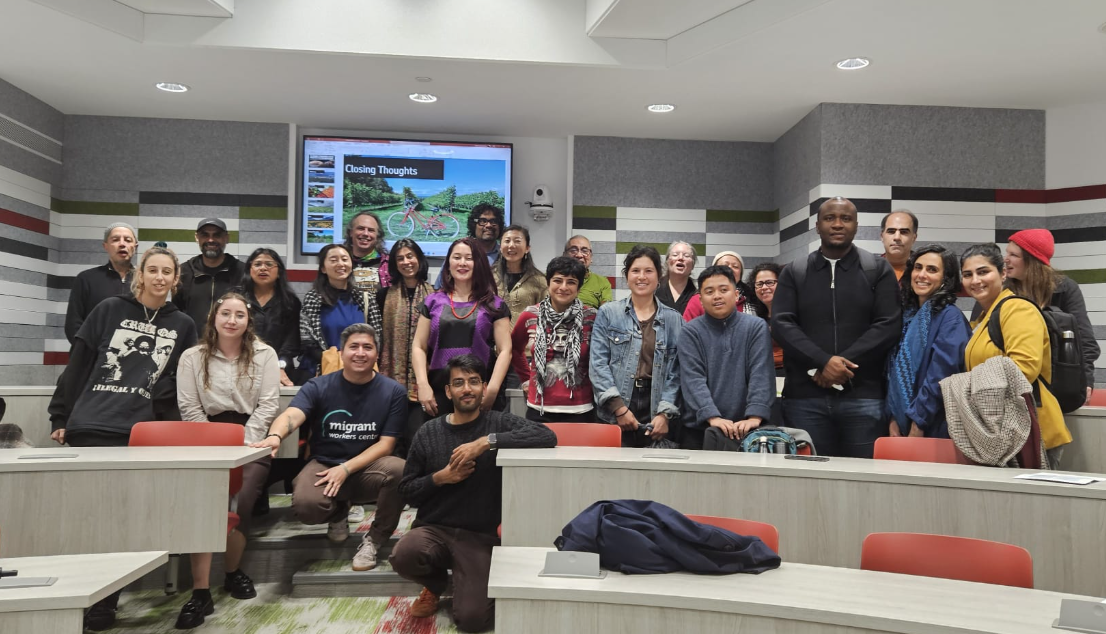
This event was intended to merge histories and lessons of farmworker justice for present and future contexts. At a Harbour Centre full house, which included dozens of farmworkers logged into the event online from farms in rural Canada and from their home countries, speakers moved attendees with their knowledge and lived experience of multi-racial, transborder, global, and intergenerational struggles for farmworker justice.
Opening: Day of the Dead altar honouring deceased migrant workers and their allies
Regina Baeza Martinez, recent SFU Sociology Masters graduate and member of Justicia for Migrant Workers, BC, opened the space with a heartfelt land acknowledgement, tying Coast Salish Indigenous Nations with the Indigenous lands that migrant farmworkers come to from the Global South.
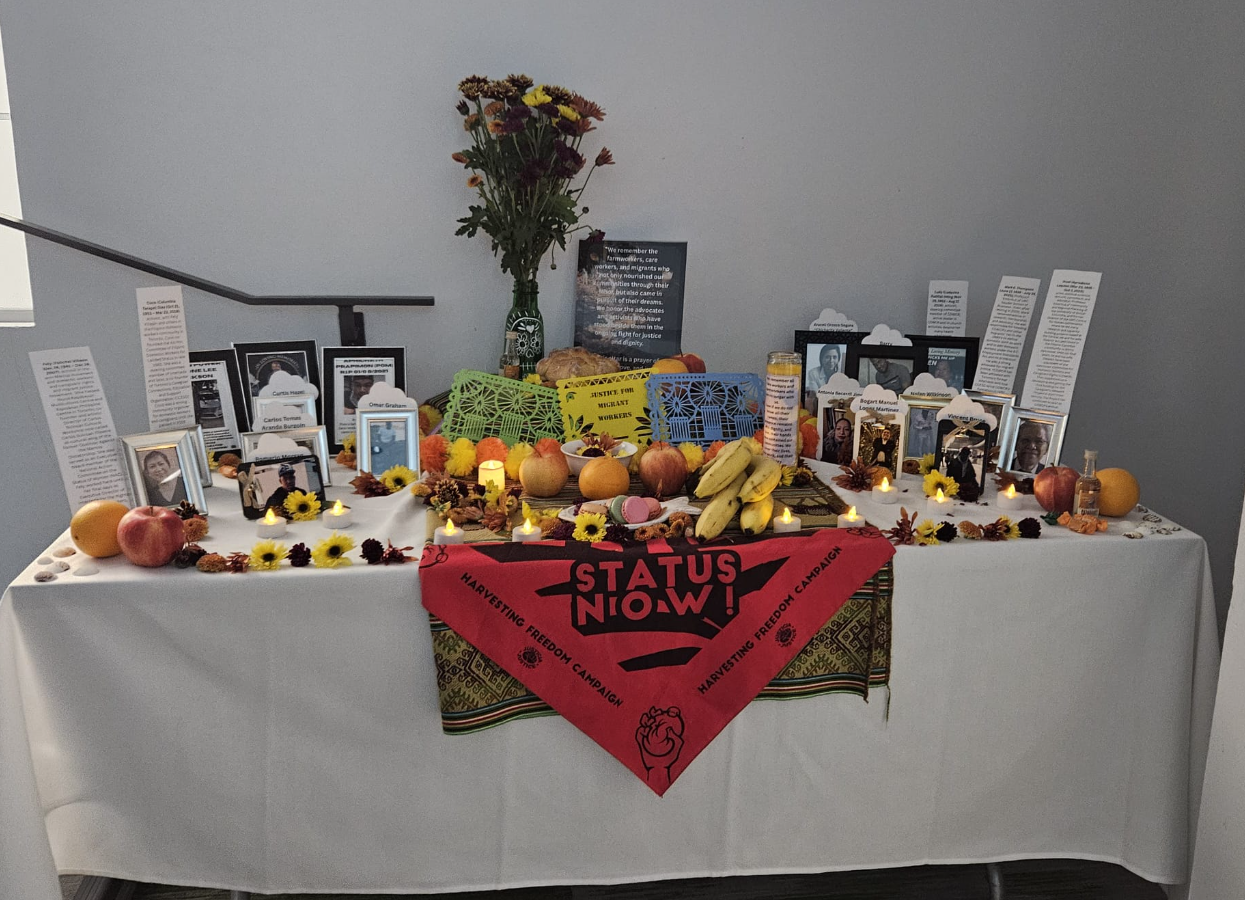
Acknowledging that the event took place close to Day of the Dead commemorations, an important Indigenous and mestizo tradition throughout the Americas, the event included a beautiful, powerful altar curated by Paola Quiros (Latinx queer educator and ritualist), which included names and pictures of im/migrant farmworkers and caregivers, and allies, who passed away in recent months.
Chris Sorio, Secretary General of Migrante Canada, started the event by reading the names and gave an emotive speech about those whose work and lives continue to inspire the movement for migrant justice: “Beloved sisters and brothers, we gather in remembrance of those who left their homes with courage in their hearts and labor in their hands, but never return, we remember the workers who built lives across oceans, who came here, planted, harvested and healed, whose sweat waters the boiled soil, whose names are often forgotten by the world that they help sustain.”
Highlights from first round of conversations:
To start the conversation, SFU historian Dr. Anushay Malik traced the formation of the Canadian Farm Workers Union in the 1970s to existing relationships and solidarities within the South Asian diaspora in British Columbia. She explained that this movement did not start with farmworkers per se, but was a concerted response among South Asian students and activists to the settler-colonial violence and racism experienced by their community and driven by the inspiration of the Naxalbari rural struggle in India. Activists including Marxist rural sociologist and SFU Professor at the time, Hari Sharma, and Raj Chouhan, current Speaker of the Legislative Assembly of British Columbia, were the main catalyst to organizing marginalized Punjabi farmworkers. They went door to door to mobilize workers and their families, addressing them in their own language. Dr. Malik stressed:
“That relationship with the community comes before anything else. So, what I mean by that is that people from the outside who don’t speak the same languages as community members may not know what matters to community members who formed the Canadian Farm Workers Union. [Outsiders cannot] see the broader solidarities, which were based on the work that they had been doing prior to, in fact, becoming migrants within the settler colonial context of BC.”
Additionally, Dr. Malik contextualized this historical period as an important juncture for farmworker organizing in North America, with César Chávez and Dolores Huerta leading the charge in California fields to organize farmworkers through the United Farmworkers of America (UFA). Dr. Malik reminded us of this important labour history and the transnational and global solidarities that propelled the farmworker movement, with the Canadian Farmworker Union reaching out to Cesar Chavez, inviting him to British Columbia to work directly with them to intensify their organizing efforts in the province.
Byron Cruz, a long-time labour organizer working with the BC Federation of Labour’s Occupational Health and Safety Centre’s Migrant Worker Program, continued with an explanation of the new face of farmworkers in BC. While South Asian immigrant workers continue to work in BC fields, there are also new faces in the province’s farmland, he explained.
Byron noted that “faces from Mexico, from Guatemala, from Jamaica and other Caribbean countries, from the Philippines and also from Vietnam, some Asian countries also, and those are the faces of migrant workers now, but with similar issues as decades ago.”
The majority of farmworkers are now migrants, meaning that they are in the country temporarily and not through a permanent immigration stream. Yet the precarity, racism, and exclusion in the law remain the same for these workers with the addition of a closed work permit that ties each worker to a single Canadian employer. This means that a migrant farmworker does not have labour mobility and cannot work for a Canadian employer that is not specified in their contract upon departure from their home country.
Byron emphasized that migrant workers face “similar situations of systemic racism, systemic attacks, especially when we have heard from federal and provincial politicians – even the premier, being hard on migrant workers.”
While migrant farmworkers are vilified in the national context, they are also policed and controlled in their daily lives by new technologies: “they [employers] are using those bracelets on workers, like a GPS on workers, to keep the control on them to know where they are, to know how long they are taking to go to the washroom, and at the end of the three months, they calculate the amount of time that they take to go to the washroom…” Byron stressed that migrant farmworkers continue to be excluded from social programs such as Employment Insurance even though they pay into this system and are enrolled in healthcare in the province after three months of work but cannot count on full and proper treatment and support.
Chris Ramsaroop, organizer and founding member of Justicia/Justice for Migrant Workers, brought into conversation the Ontario context where the contemporary national farmworker movement began. He explained that Justicia was formed as a response to a wildcat strike organized by migrant farmworkers in Leamington, Ontario, known as the greenhouse capital of Canada. He cautioned of the tendency to infantilize and paternalize migrant workers as if they do not have their own agency to fight back and resist. He relayed how wildcat strikes have been common among workers throughout the history of migrant labour programs in Canada, attesting to workers’ power and agency. However, social services, the healthcare system, and legal structures serve to undermine workers’ agency and erase the history of violence that has underpinned their lives as migrants in Canada. Justicia’s work, he explained, has focussed on multiracial organizing rooted in freedom, liberation, and emancipation.
Chris also explained it is misguided to quantify wins instead “struggling means you try to organize, you reflect, you realize you’re going to win some things and you’re not going to win a lot, right? So it’s an ongoing process of trying to understand the world around us … part of the important work has been with a lot of these injured workers who are online, we won some extremely important cases on Ontario as a result of the organizing and have been pushing for changes around the cuts to benefits for injured workers when they go back to Mexico and the Caribbean…”
In closing, Chris stated that this is definitely part of an intergenerational conversation:
“ I’ve been at this a long time, and now it’s time for us to push and to start getting the next generation ready to take the stuff on for us. And the struggle continues.”
Dr. Vasanthi Venkatesh, Justicia organizer, law professor and head of the Migrant Farmworkers Clinic in the Faculty of Law, University of Windsor, offered a critical reflection of the role of the law as the main architect of farmworkers’ exploitation through a system of modern-day plantation. She explained how this system is maintained by a “legal regime of exceptions for agriculture, a regime that includes trade subsidies that not only increase the wealth of Canadian farmers, but also destroys Indigenous and subsistence farming in the Global South, dispossessing people from the land so they can later provide the main raw material for Canadian farms, an endless sea of racialized labour and exclusions in employment law, no overtime pay, no limits on working hours, no employment insurance, barriers to unionization.”
Additionally, she explained that immigration policy serves the ends of exclusion for migrant workers who cannot apply for permanent residency despite their specialized agricultural skills and experience living and working in Canada for decades. The call for permanent residency status is crucial.
She stressed, however, that “our task is to ensure that this call maintains a liberatory, anti-colonial practice, and that the fight for status is part of a much larger fight, most of which has been mentioned in the fights against these myths, the fight against global economic policies, against racial capitalism. And so our goal cannot be to make the plantation more efficient, more good, to these piecemeal rights. Our goal has to be to stand with Alicia and workers in the altar and to tear this plantation down root and branch.”
Further conversations sprang from these provocative introductory remarks from all speakers. And this event demonstrated the power of intergenerational and global-local solidarities and the need to carve spaces in the academia, at SFU specifically, to host these important conversations for the community at large for collective learning and action.
The Migrant Summit, BC – Vancouver October 18-19
Following this event, Dr. Encalada Grez and Regina Baeza Martinez co-organized and hosted an intensive two-day Migrant Summit for grassroots migrant justice organizations and organizers in British Columbia to build relationships and capacity within the migrant justice movement at a time of growing anti-immigrant backlash, authoritarianism, and emboldened white supremacy.
The two day event included workshops and knowledge exchange such as organizing through and beyond the law; grant-writing for grassroots organizations; organizing lessons from the United States with a speaker from the National Day Laborer Organizing Network (NDLON); and ethical and migrant justice movement-based research. A toolkit and short-film are currently in progress to share the learnings and conversations from the Summit for grassroots migrant justice organizations.
You can find more information and hear from the participants of the Summit in the video:
In January 2026, Dr. Encalada will offer a seminar based on her praxis of collapsing the walls between the university and the community called “How to Make Change: Community-Labour Organizing and Action”.
Event organizer/participant bios:
Regina Baeza Martinez is a Mexican-born research professional and organizer based in occupied Coast Salish territories. Since 2021, she has managed and supported various research projects, with experience in Indigenous, migrant, and activist-based initiatives. A recent graduate of the Sociology Master’s program at Simon Fraser University. Regina was a Fellow at SFU’s Community-Engaged Research Initiative and the Understanding Precarity in BC project. Her Social Sciences and Humanities Research Council-funded research highlighted how migrant farmworkers create a sense of home in Canada despite their legislated disposability. She is also a member of Justicia for Migrant Workers-BC.
Anushay Malik is a Senior Lecturer in the Department of International Studies and Global Asia at Simon Fraser University. Recently, she has ventured into public history, co-curating two exhibitions that utilize counter-storytelling methods to highlight cross-border narratives of migration and resistance that are often overlooked. She co-wrote Union Zindabad!, a book chronicling the history of South Asian labour action in British Columbia, which included a section on the Canadian Farmworkers Union and their struggles.
Chris Ramsaroop is a founding member and organizer with Justice for Migrant Workers in Ontario and an Assistant Professor at the New College, University of Toronto. He is also a co-director of the Migrant Farmworkers Clinic in the Faculty of Law, University of Windsor.
Byron Cruz is an organizer and outreach coordinator for the BC Federation of Labour’s Occupational Health and Safety Centre’s Migrant Worker Program in Vancouver. He is also an active member of the Sanctuary Health Collective and Migrant Rights Network, a grassroots collective advocating universal access to healthcare, education, and social services for all.
Vasanthi Venkatesh is an Associate Professor of Law, Land, and Local Economies, University of Windsor, Faculty of Law. With Justicia for Migrant Workers in Ontario, she administers the Migrant Farmworkers Clinic at Windsor Law, the first legal clinic for migrant farm workers in Canada that is based on law and organising principles.
Paola Quiros-Cruz, aka La Maga, is a queer, gender-fluid Colombian immigrant living on the unceded, stolen, and ancestral lands of the xʷməθkʷəy̓əm (Musqueam), Sḵwx̱wú7mesh Úxwumixw (Squamish), and səl̓ilw̓ətaʔɬ (Tsleil-Waututh) Nations. They identify as a bruja, roots and ancestors venerator, art ritualist, yerbatera, and collective conjurer.
Evelyn Encalada Grez is an Assistant Professor, Sociology and Labour Studies, Simon Fraser University and co-founder of Justice for Migrant Workers in Ontario and is currently reviving its BC chapter.
Chris Sorio is currently the Secretary General of Migrante Canada—a grassroots organization supporting temporary foreign workers and immigrants. He is pursuing a Masters Degree in Critical Human Geography at York University, Toronto. Living through torture under Martial Law in the Philippines in the 1980s, he was forced to migrate and has since been a tireless advocate for im/migrant justice in Canada and beyond.
Full list of sponsors and community support:
The David Lam Centre
The Labour Studies Program, SFU
Understanding Precarity in BC (UP-BC)
Justice for Migrant Workers, J4MW, BC and Ontario
Migrant Worker Centre, BC
Vancouver Committee for Domestic Workers and Caregivers Rights (CDWCR)
Migrant Journeys
Health and Safety Centre, BC Federation of Labour